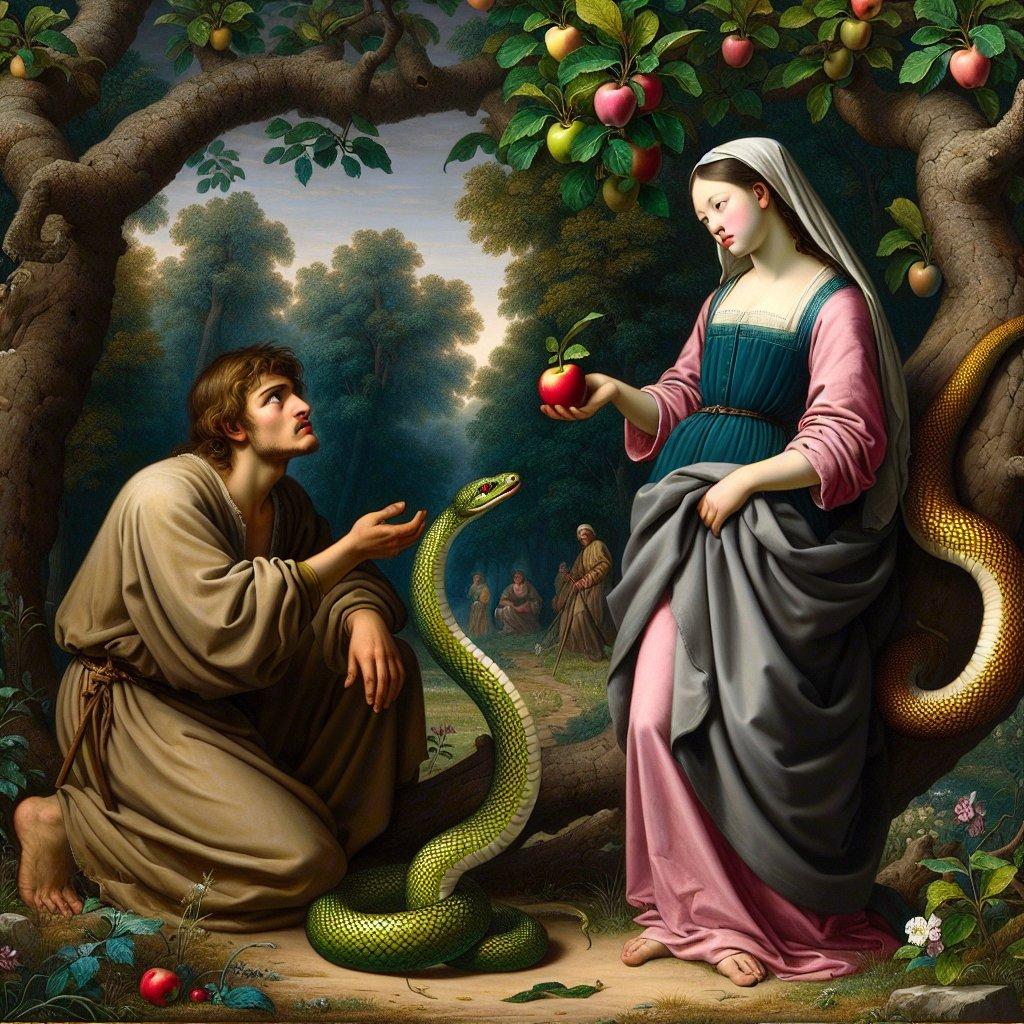
When I pose this question to my students, they overwhelmingly assert that, yes, the devil was indeed present and causing trouble in the Garden of Eden. In fact, many believe that it is not Eve, but Satan—in the guise of the snake—who tempts Adam to eat the fruit. While it is clear that both Adam and Eve are present during Eve’s discussion with the snake, and it is equally clear that the snake is rather convincing, the notion that the snake is anything more than just a snake is a very common misconception.
Nowhere in the story does it state—or imply—that the serpent is actually a demonic figure of any kind, and most certainly not the Devil or Satan of later (much later) Jewish and Christian lore. The anonymous author or authors of this story had no real understanding of a satanic figure capable of undermining divine dictates. During this time period, God, and God alone, is the harbinger of good and evil. God himself states this emphatically in the book of Isaiah:
I am the Lord, and there is no other. I form light and create darkness, I make weal and create woe; I the Lord do all these things. (Isaiah 45:6-7)
The idea of an evil being—Satan—who stands in opposition to God does eventually emerge in Jewish and Christian thought, but this idea takes centuries to materialize. The snake, therefore, is simply one of God’s creatures.
Milton’s Satan and the Serpent: A Poetic Invention
Incidentally, it is the English poet John Milton who is the first to cast Satan in the role of the serpent in his classic, Paradise Lost (1667). In Milton’s poem, Satan is a highly developed figure who commands a legion of other demons. Milton’s Satan slithers into the Garden of Eden, assumes the form of a snake, and lures Adam and Eve to sin. While this scenario is entirely absent from the biblical account, it nonetheless serves as an excellent example of how certain writings outside the pages of holy writ can sometimes bleed into our religious narratives.
Over time, the biblically illiterate masses accepted Milton’s work of fiction as part of their gospel truth, assuming his epic poem came from the pages of the Bible. Had they actually read the Bible, they would have understood Milton’s poem as a work of fiction and his characterization of Satan as the snake in the Garden of Eden as part of Milton’s genius imagination. Of course, many of Milton’s countrymen and women were illiterate, so this conflation of fact and fiction is somewhat understandable.
The Danger of Blending Fiction with Scripture
But four hundred years later, this sort of blending of stories continues. Even today, we often fail to check the facts and assume that if a preacher or teacher says something, it must be true. My hope is that after reading The Birth of Satan, you will no longer simply accept the conventional wisdom or rely on hearsay, but will instead feel confident in turning to the source—the Bible—to read and understand the story for yourself.
© T.J. Wray. This post may not be used, in whole or in part, without the author’s written permission. For inquiries, please use the Contact page.