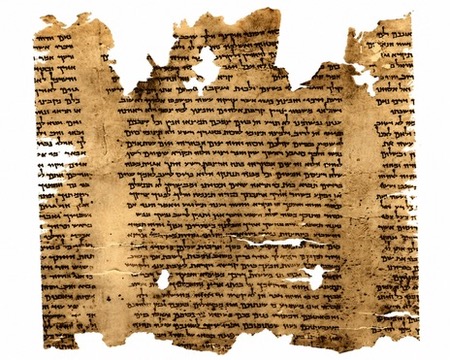
Several books of the Bible announce their primary author in their opening lines (Micah: “the word of the LORD that came to Micah,” Galatians: “Paul . . . to the churches of Galatia”). Others do not (Genesis: “In the beginning, when God created the heavens and the earth”; The Gospel of John: “In the beginning is the Word”). The titles given to biblical books, such as 1 Samuel and the Gospel According to Mark, often suggest authors, but these titles are actually appended to the books after their composition. In fact, in the books of Samuel and the Gospel of Mark, there is no indication that they are written by the prophet or saint with whom the book has come to be associated and the truth is, we do not know who wrote them.
The pious have always considered the contents of the Bible as inspired by God, but just how this all transpires is a bit of a mystery. Inquiring minds, however, demand and produce a set of traditions about the authorship of various books in the Bible. According to tradition, Moses writes the first five books of the Bible (the Pentateuch or Torah), David writes most of the Psalms, Solomon authors Proverbs and Ecclesiastes, and Paul pens the Epistles. Historians, however, are not satisfied with these answers, and a vast scholarly enterprise, with many competing theories, has been devoted to naming “the real authors” of Scripture.
The JEDP Documentary Hypothesis and Biblical Authorship
Most of the books themselves do not directly name their authors and an unbiased reading makes some of the traditional authors suspicious. For example, does Moses really write the account of his own death in Deut 34:5? Does Paul write certain letters generations after his death? To answer such questions, scholars have developed an alphabet soup-roster of hypothetical authors such as J, E, D, P, Dtr, and Q to refer to the actual authors of biblical books. Let’s consider two of these authors, J and P for a moment. Many people are unaware that there are TWO creation stories in the first three chapters of Genesis, written by two different authors—( “P” and “J”)—and that P and J are writing for different audiences at different periods of time. P writes the story of the six-day creation ad J writes the story of Adam and Eve. In addition to J and P, scholars have discerned at least two other sources for the material found in the Torah/Pentateuch—E and D—thus, the four letters are commonly referred to as JEDP, or the “four source documentary hypothesis.” This means that, if this hypothesis is correct (and remember, a hypothesis is just a fancy word for theory or educated guess), then the Torah or Pentateuch is compiled from a variety of sources, which might also include oral traditions.
Understanding J, E, D, and P: The Four Biblical Sources
The two earliest writers are J and E. Recall that J, or the Yhawist (from Jahwist, in German) refers to God as Yhwh, hence, J’s nickname. The E source, on the other hand, consistently refers to God as Elohim, the more generic term for God, thus the designation “E.” The J source is largely an epic narrative that traces the emergence of Israel as a nation and is likely written during the ninth century B.C.E. Most scholars think that J lives in Judah, since his concerns reflect Jerusalem and the monarchy (typical southern concerns). Material from E originates in the north and is written around the eighth century B.C.E. This earlier source seems more concerned with largely northern issues, such as covenant and the conquest of the land. This also points to something obvious: As in the USA, there are vast differences between northerners and southerners in Israel—in antiquity and even today.
The Deuteronomist or D source reflects concepts found in the Book of Deuteronomy, specifically, obedience to God and covenantal loyalty, and is probably written during the sixth century B.C.E. Finally, the Priestly or P source is concerned with priestly functions and religious laws. Most scholars date P to the fifth century B.C.E. or later.
Arguably, this is a very brief description of the four-source documentary hypothesis, but the most important thing to understand is that these four versions are woven together by a later editor or editors—usually called a redactor or redactors—into its present form. As scholars continue to debate the authorship of various books of the Bible, many have even abandoned the JEDP theory altogether. I mention it here only as an example of how we have come to understand the piecing together of different stories into a cohesive narrative by the biblical redactor.
Other ascriptions of authorship are designed to give the writing the air of antiquity and authority. The older and more revered the author, the better. The impulse to firmly associate texts with respected elders as a way of expressing their significance has guided the traditions that link the biblical books with the greatest names of biblical history, thus the Torah is often referred to as the “Five Books of Moses” and the Psalms are ascribed to King David. This is a common convention in antiquity, and we see this practice at work in more modern history. For instance, scores of towns in New England (and elsewhere) display plaques on various buildings that claim: “George Washington slept (or ate or visited) here.” However tenuous the connection between a certain place and the first President of the United States may be, such connections make the places seem more important.
Biblical Authorship: What Scholars and Traditionalists Agree On
Scholars and traditionalists often clash over such issues as authorship, but sometimes, they DO agree: It seems that Paul does write Romans and Amos does speak many of the oracles contained in the book that bears his name. The jigsaw puzzle of who writes what when for whom is an interesting academic exercise, but has little bearing on the faith life of believers who hold the Bible so dear. The scholarly debate and endless quibbling over authorship, to some, is like arguing over whether a fine wine tastes better in crystal glass or a plastic cup; it is the wine that matters, not the glass or cup.