“Who am I?” is a timeless, existential question of self-identification. Modern women might explore this question in terms of the concrete realities of the Great Juggle: family, career, and the struggle to carve out a sliver of time devoted to self. In the world of biblical antiquity, however, women would likely answer the question, “Who am I?” in terms of belonging to a particular man: The daughters of Lot; Job’s wife; the sister of Absalom; the mother of Samson. A deeper reading of the Hebrew Bible’s women stories, however, presents us with a larger question beyond “Who am I?” The real question for biblical women is “Whose am I?” and the answer is a resounding: “You belong to God.”
Some scholars speculate that the Bible’s stories about women are actually allegorical, reflecting the status of Israel, as a nation, for Israel, like her women, was often powerless against her enemies, both foreign and domestic. Weak and marginalized nations and people often resort to devious means to survive. It is not surprising, then, that many of the women stories in the Bible feature a trickster type character who uses unorthodox means—including lying, cheating, and other forms of deception—to bring about God’s plan. As such, tricksters are both admired and respected in the Bible for their skillful use of manipulation. The three women profiled in this paper—Rebekah, Tamar, and Rahab—are representative of the types of women stories found in the Hebrew Bible and they are tricksters. Like most of the women stories in the Bible, these women act as agents of change.
The wife of Isaac, Rebekah (Gen 24:10-67; 26:6-16; 27:5-38; 28:5-6; 29:12-13; 35:8; 49:31), is known for her cleverness and single-minded devotion to her son, Jacob, who represents the continuation of God’s promise to Abraham. This promise (Gen 12: 2-3) assures the acquisition of the land, an enduring relationship with God who will extol blessings upon future generations, and a proliferation of descendants.
After twenty years of barrenness (in the Bible, viewed as a curse or punishment from God), Rebekah conceives twin sons, whose in-utero jostling portends their future conflict. Rebekah asks the Lord about the brawling in her belly, and the Lord responds with an oracle:
“Two nations are in your womb,
and two peoples born of you
shall be divided;
the one shall be stronger than the other;
the elder shall serve the younger.” (Gen 25:23)
This oracle designates Jacob—who is the second twin born—as the one who will continue God’s promise. Rebekah makes the fulfillment of this oracle her life’s mission. Jacob’s brother, Esau, is presented as a hairy, dull, wild man who likes to hunt while Jacob is a mama’s boy who is interested in more domestic chores, like cooking. His culinary skills prove profitable when he jokingly offers his brother some lentil soup in exchange for Esau’s birthright and the hungry Esau readily gives away his birthright for the soup (Gen 25:29-34).
Apparently, Esau can still gain his inheritance if he receives his father’s final blessing. Isaac, old, blind and on his deathbed, asks his favorite son, Esau, to hunt and prepare a meal for his father so that Isaac can bestow his special blessing upon Esau. Rebekah, like many women in the biblical world, gathers information by eavesdropping and when she learns of Isaac’s plan to give Esau the blessing, she enlists the help of Jacob and together they pull off one of the Bible’s most amazing hoodwinks. While Esau is off hunting, Rebekah takes a kid from the herd and prepares a meal for Isaac. Next, she disguises Jacob in his brother’s gamey smelling clothes, covering his smooth skin with the hide of the kid to give him the wooly feel of Esau, should Isaac touch him. Although Isaac is initially suspicious, Rebekah’s plan works and Isaac gives Jacob Esau’s blessing.
When Esau finds out, he vows to kill his brother. Again, Rebekah works to fulfill the oracle, arranging to send Jacob to Haran and out of harm’s way (Gen 27:42-45). While modern readers may object to Rebekah’s favoritism and deceit, the biblical author would disagree. Rebekah does what she must to protect the bearer of the Promise and thus fulfill God’s plan for Israel.
Like Rebekah, Tamar manipulates events to help bring about God’s plan—in this case, she will bear a son in the line of King David. Tamar’s first husband, Er, does something—the Bible does not tell us what—that greatly offends God and God kills him (Gen 38:7). Under the law of levirate (Deut 25:5-10), which decrees that a surviving brother must marry his dead brother’s widow, Judah (Tamar’s father-in-law) gives Tamar to Er’s younger brother, Onan. If Tamar has a son with Onan, according to the Levirate law, her firstborn son is recognized as Er’s and assumes primacy over Onan when it comes to inheritance. Obviously, it is not in Onan’s best financial interest to have a child with Tamar, so he practices coitus interruptus, an action that prompts the Lord to kill him, too (Gen 38: 9-10). It is not Onan’s sexual behavior that provokes the Lord; rather, it is his refusal to honor the law of levirate.
Tamar is once again without a husband, but she is still entitled to have children from Judah’s family and the levirate demands that Judah give her his only remaining son, Shelah, who is too young to marry. Judah sends Tamar away to her father’s house—single and barren, both viewed as a great humiliation in the world of biblical antiquity—to wait until Shelah is old enough to wed (Gen 38:11). At least this is the story he tells Tamar. The reader, however, knows the real story. Judah thinks Tamar is a toxic bride and fears losing another son (Gen 38:11). It is clear that he has no intention of allowing Shelah anywhere near Bridezilla, not now, not ever.
Time passes, Shelah grows up, and Tamar eventually realizes her father-in-law’s betrayal. Her situation seems desperate, but things change quickly when she hears that Judah will be passing through town (Gen 38:13). Tamar seizes the opportunity and swings into action to take what is rightfully hers—a child from the family of Judah. Removing her widow’s garb and covering her face with a veil, Tamar waits on the side of the road, the place of streetwalkers, beggars, and unescorted women with dubious reputations (Gen 38:14). Her disguise reminds us of Rebekah’s hoodwinking of Isaac and the Esau costume she pieced together for Jacob.
When Judah spies her on the side of the road, he approaches the faux hooker and the two talk business:
Judah: “Come let me come in to you.”
Tamar: “What will you give me, that you may come in to me?”
Judah: “I will send you a kid from the flock.”
Tamar: “Only if you give me a pledge, until you send it.”
Judah: “What pledge shall I give you?”
Tamar: “Your signet and your cord, and the staff that is in your hand.” (Gen. 38:16-18)
To leave his signet and cord with her in pledge is the modern equivalent of giving her his driver’s license and Judah will come to regret this lapse in judgment. Three months later, Judah, who holds a position of authority in the local government, receives word that “…Tamar has played the whore…she is pregnant as a result of whoredom” (Gen 38:24). The penalty for adultery is death (Deut 22:23-24; Lev 21:9) and Judah demands that Tamar be burned. As she is brought out for execution, she comes face-to-face with the father-in-law who betrayed her. But Tamar holds the ultimate trump card. Producing the items Judah left in pledge during their brief sexual encounter, she says: “It was the owner of these who made me pregnant…Take note, please, whose these are, the signet and the cord and the staff” (Gen 38:25). And with that, the condemned Tamar is vindicated. Like Rebekah, she gives birth to twin sons, Zerah and Perez, the latter, an ancestor of the great King David (Ruth 4:18-22).
Our final trickster, Rahab (Josh 2; 6:16-25) is the courageous courtesan who helps continue the original promise God made to Abraham, in this case, the assurance of the land (Gen 12:1-4). Rahab’s story begins as the epic adventure of Israel’s exodus from Egypt and forty-year sojourn in the wilderness draws to a close. Joshua leads the Israelites to the edge of the Promised Land, but there seems to be a slight problem: Apparently, there are people already living in the land that God deeded to Abraham (Gen 12:6-7).
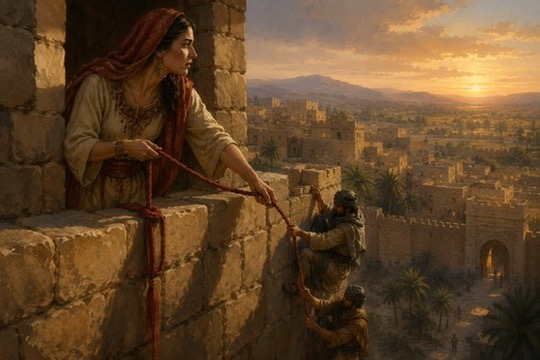
Joshua sends out two spies to assess the situation. Upon entering the city (Jericho), Joshua’s spies head immediately to the local whorehouse (Josh 2:1). The story does not tell us why the men decide to make a pit stop at the bordello. Perhaps those forty years of wandering in the wilderness has something to do with it or maybe they sought to gather secret information about the city from the working girls sometimes coaxed from clients in the throes of passion.
The Madam, Rahab becomes their protector, confidant, and friend. The king of Jericho learns of the spies’ presence in his town and orders Rahab to turn them over (Josh 2:3). Rahab lies and says that the men have already left, when in reality, she has hidden them safely on her roof, under stalks of drying flax. When the coast is clear, this not-so-good Canaanite girl reveals her motives for protecting the enemy. “The Lord, your God is indeed God in heaven above and on earth below” (Josh 2:11). Rahab’s confession of faith makes her the first convert in the Promised Land. Of course, prostitutes do not give away their services for free; Rahab asks the spies to spare her and her family when the Israelites attack Jericho (Josh 2:12-13). The spies agree, and when the city is attacked and the inhabitants slaughtered, Rahab and her family are indeed spared. Modern readers cannot help but note that Rahab betrays her own people, and that her treason brings about much death and destruction. But, from the perspective of the biblical author, Rahab is a great heroine, for her actions allow Israel to take possession of the Promised Land.
Rahab, the unlikely heroine who heralds Israel’s occupation of the land, reminds us of Rebekah (Genesis 24-27) and Tamar (Genesis 38), sister tricksters, whose resourcefulness and cleverness play a part in God’s ultimate plan for Israel. The greater message, of course, is aimed at the reader, who is also called to serve the ineffable, unknowable God.